I'm going to start posting short write-up's of game's I'm playing under this "Now Playing" heading. These games below were played at a friend's house yesterday over an inordinate amount of time. There's probably a maximum of 4 hours worth of gaming contained in what I played (add a half hour to learn Star Wars), but in a total of about 8 hours. I felt the whole experience of spending this day gaming unfulfilling as a whole, even though I enjoyed all the games I played.
First a friend and I played a game of Magic: The Gathering: Danger Room. The Danger Room is a variant of Magic that really gives me much of what I want out of the game. Players play from a common deck that's built to emulate the feel of early Magic. Each player has a "Mana Cache", a set of 5 basics, and 5 allied ETBT duals. This is my second time playing my Danger Room and I really think this is the format for me. I'm going to hold onto my cubes, EDH decks, and pauper decks for the time being, but I'm ready to chuck the rest.
Got in a bunch of rounds of Toc Toc Woodman. This game is a jenga-like dexterity game. You take a toy axe and swing at a tree to knock off pieces of bark, the bark is worth positive points and the center of the tree is worth negative points. This is pretty fun, but I wouldn't recommend playing with more than 4 and probably it's best with 2. Our 2p games were pretty tense back and forths, the 3 and 4 player games were more swingy as whoever would collapse the tree would of course lose, however the other players would be left with scores between 2-4 points and it seemed almost at random who would win when someone would lose. A fun time killer, something to break out if you're waiting for a game to wrap.
Played one game of Star Wars The Card Game. This game is a breeze to learn, which is very nice. I can't comment on it much since I only played 1 game but it was pretty tense, and came down to the wire with the rebels winning with the death star at 11.
Then we played two 5 player games of The Resistance: Avalon. This is my favourite game, and I LOVE the roles Avalon added to this system. in both games we played with the setup of Merlin, Percival, Plain Old Rebel, Morgana, and Oberon. This setup made for a pretty good game, though I think I'd like to swap out Oberon for Mordred in this 5p setup. The original game played fantastically with 7-8, but 5-6, and 9-10 felt like it needed something, and what it needed is these roles. They add so much to the game, you can have a tight 5p game where almost everyone knows something, or a wild 9 player game with accusations flying. Giving players information about the game REALLY helps liven it up, if you're at all interested in secret team/social deduction games this is the best by miles.
Saturday, March 16, 2013

Tuesday, November 15, 2011

pukeamania is dead!
My best intentions of writing about dated pro wrestling have failed. This is pretty common for me, all my life my interests have stayed the same, but have always had me as the knot in a tug-o-war. Sometimes I download a terabyte a month of wrestling videos and get phone calls from my ISP, and sometimes I spend whole weekends gaming. I have a good number of hobbies but I tend to give one more attention than another for extended periods of time before switching to another. As such, I am trying to focus my writing here on what's interesting me at the moment as opposed to a specific topic.
Much of this year I've spent doing two things with my free time; helping restart The Mr. Roboto Project, and exploring board games. In a way these have complimented each other well, and giving attention to both of these things together has really pushed me toward sandwiching community organizing with gaming. Though I still find time to watch wrestling and science fiction, go to the cinema, read comics, and find some new music, all kinds of things teenage weirdos do.
Board gaming, for me, is a progression/evolution of my years spent playing Magic: The Gathering. They have all but replaced Magic to me and I couldn't be happier about it. Magic is a game I learned in sixth grade and have revisited periodically throughout my life (see paragraph 1), however my latest stint with it caused the game to grow so stagnant with me that when I would devote hours or days to playing it, I would enjoy very little of that time. Board gaming on the other hand offers a seemingly unlimited number of options to match moods and tastes. Past that I find it inspiring, I tear through rule books and have spent a bit of time exploring design and social aspects of gaming (playing).
I'm looking forward to this new direction here and hoping I can write a bit more frequently.
Thursday, January 6, 2011
Thoughts on Rasslin' Rags
Growing up, in regard to magazines, two publications immediately come to mind as being a constant presence in my life, those being Nintendo Power, and WWF Magazine. Without getting too far off track, Nintendo Power was a printed saviour in it's time. Before the internet, magazines were very important to gaming culture, as it's where strategies and secrets were born, and in the 8-bit Nintendo era, you really needed those tips.

WWF Magazine on the other hand, served no practical purpose. It was a combination supplement/advertisement. You could not read WWF Magazine and know what was going on in the promotion. If there was a Pay-Per-View coming up, you would get the run down on that (you know, so you could "call your local cable company"), but as a whole, the magazine was kind of a random assortment of articles. Some would be profiles of new Superstars, there would be interviews, some "behind the scenes" looks at wrestlers or events, and of course some buildup about the top couple feuds.
These books served not as a storyline summary, like other wrestling magazines of the time, but since this was WWF's in house publication, it was more used to build the characters. Bobby Heenan on the set of a western, Huk Hogan making an apperance on Regis and Kathy Lee (to promote No Holds Barred), Ted Dibase relaxing in one of his many mansions, or Ron Garvin talking about going from wrestler to referee. Before WWF had 6 hours of programing to fill per week, they had to get more creative to flesh out their characters, and I think they did an excellent job with this magazine.
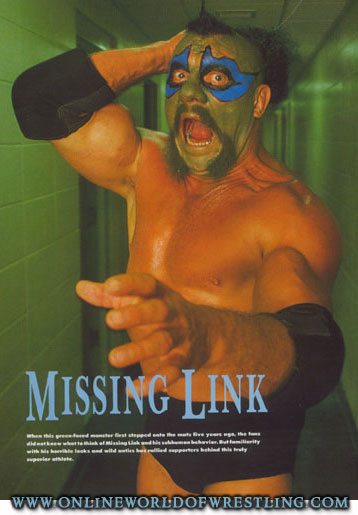
Looking through the pages of one, you'll note it looks nothing like a wrestling magazine of it's time. In the 80's nearly every wrestling magazine was fully in black and white (save for a few full page colour photos in the middle, like a mutated "Tiger Beat", The Missing Link replacing David Cassidy), and featured little in the way of design. There would also be somewhat sleazy ads for cat fight videos (for $59.95 a pop), and questionable "muscle building" programs. WWF Magazine had none of this, it was full colour, featured gorgeous design, with brilliant two page layouts, and for the most part, had no advertisements (looking past the fact that the whole book was an advertisement!).

I say this not to take away from other wrestling publications, but only to draw contrast. I feel magazines like "Inside Wrestling" and "Pro Wrestling Illustrated" are much more important to the sport, as they are much more news oriented. They paint the image of pro wrestling in America, they covered every promotion and offered criticisms. I do know they weren't unbiased, but reading them now, it takes little effort to read between the lines.
This leads me into something I've been wanting to do for a long time. Many wrestling fans, myself included, are d.i.y. historians and archivists. Wrestling prior to the mid-80's has been for the most part forgotten. Not in the way that it isn't considered relevant, but in that the majority of wrestling footage from the early 80's or prior has been lost (due to studios recording over master tapes, as was common in the 60's and 70's) or is locked in a vault in Stamford, Connecticut, being released as quickly as is profitable (read: very slowly).
It's easy to figure out why wrestling fans love video, it's a very visual sport. You could lack every sense other than sight and enjoy it just the same. Wrestling boomed with cable, giving many wrestling fans a familiar feeling of watching a show they haven't seen since it's first broadcast two decades ago, and most wrestling footage hasn't seen a commercial release. It's impractical to release it all because there's so much of it, and very few buyers, causing wrestling fans to turn to one another to trade tapes to complete collections.
In my pursuit of digital wrestling media, something I've rarely come across (only once actually) is a digitized wrestling magazine. I can't be the source of any rare wrestling videos, I just wasn't born early enough. Most footage from after the first wrestling boom is out there somewhere, if you look hard enough, but wrestling magazines seemed to have fallen through the cracks. Maybe they don't offer the same level of entertainment, or maybe they're simply not as flashy as a video, but they're still important to the story of pro wrestling. So maybe this could be a way of 'doing my part'.
To begin, this was sort of a test. This isn't a WWF Magazine, but instead a program, since for the purpose of getting used to working with magazines and PDF's in this manner, it has fewer pages. I did scan a full issue of the magazine prior to this, but while trying to work through a series of errors that were coming up, I lost the entire scanned issue. I also don't own every issue, and the handful that I recently grabbed while home for the holidays are rather spaced out, so don't expect anything to be complete or chronological, but do expect them to be high quality. This first release (and each that will follow) is a 300 dpi full colour PDF (which explains it's size). I recommended reading this viewing the pages side by side, as to preserve the two-page layouts.
Here is the internet world premiere of WWF Program, issue 215 (47.9 MB):
This coming Tuesday is a "classic wrestling party" some friends put together semi-monthly, so expect to hear a bit about that soon, the card for this one is full of winners.
Until then, "give me a break!"
Tuesday, November 30, 2010
Thoughts on the first year of WCW Monday Nitro
Last year I started watching Nitro from the beginning, I made it to spring 1996 and then got sidetracked. I recently started again, and have made it through the first year, which I feel is an accomplishment.
The first year of WCW Monday Nitro is a textbook for how to book a weekly episodic wrestling program. EVERYTHING about the writing and pace is as close to perfect as wrestling can get. It starts out focusing on the old guard of Hogan/Flair/Savage/Sting/Luger, and continues this until the appearance of the nWo in late may 1996.
In these pre-nWo episodes, we are focused strongly on the company's top stars, and why shouldn't we be? They only have ~45 minutes of air time per week to put their product over, mid-card wrestlers can be the focus of the 2nd tier show (in this case, WCW Saturday Night). Not that the mid-card is missing from Nitro, but it's very subtle. Mid-carders appear and vanish with elegance. You never ask yourself "where is (wrestler x)" when he isn't on a show for a few weeks, because he was never a focal point.
The best illustration I can choose for this is the 1996 run of the Rock 'n Roll Express. They show up maybe once a month on Nitro, and are always in a higher profile match (v. Flair/Anderson, v. Harlem Heat, etc.), but then they are gone and you don't give it a second thought. They are used as under card talent should be, to fill a void, not to share the focus of the story.
There are plenty of quirks in this year of Nitro. The evolution (or devolution) of The Dungeon of Doom is a fun watch. They start out as the "mystical" force of monster heels bent on destroying Hulkamania, the early episodes features favourites like Kamala, King Curtis, and The Yeti. They form a loose alliance with The Four Horsemen in early 1996, from which spawns two great feuds for Kevin Sullivan (the first being with Brian Pillman, and then Chris Benoit). When the nWo angle begins, they are feuding with The Horsemen, and eventually that feud dissipates, as the focus of the show turns to "defending WCW". After this the Dungeon enters a really fledgling state of existence. When the nWo appears, The Giant has the world championship, but loses it as quickly as possible, to Hogan at Hog Wild in early August. After this The Giant takes flack for a couple weeks for having "dropped the ball", before turning on WCW. This leaves The Dungeon with no major players, but still existing and being featured on Nitro regularly.
The use of the cruiserweight division is excellent. They feel perfectly weighted in the show. When I was young and watched this show weekly, I loved the cruiserweight matches, and they were always exactly what they should have been, their own unique portion of the show, which was exciting to watch and never pulled you away from the main stories. Often these matches had no "stories", either someone wanted the cruiserweight belt or it was just a match. Simple, entertaining and effective.
The pre-nWo angle with Sting and Luger being a tag team is REALLY great and original. Since Luger's return on the debut episode of Nitro, his "alliances" seem to be torn, you can't really tell if he is a face or a heel (kind of like the Luger/DiBiase angle from WWF), but Sting trusts that Luger is his friend regardless, and Luger is loyal to Sting. This creates a really interesting tension between the two. Luger and Sting capture the WCW tag titles, with Luger cheating for the victory and Sting having no idea. This is how they pick up a few wins until people start pointing it out to Sting, and tension grows between the two, great execution. Sadly there's no payoff for this, which is sad because this is probably the second best angle of the year, trailing behind the nWo. With the nWo's arrival, Sting and Luger are both needed as top guys to defend the honour of WCW, their problems mysteriously vanish, and even Randy Savage seems to trust and accept Luger. To top this off, they unceremoniously drop the title to Harlem Heat during a title defense where the nWo ran in and distracted everybody.
This sets up a rather funny match a couple months later, where Harlem Heat are defending the titles against Public Enemy. Upon entering, the announce team is talking about how Harlem Heat is one of the best team in the sport, and the best champions to keep the tag belts away from the nWo camp. Harlem Heat then lose that very match to Public Enemy on a VERY good call by controversial referee Nick Patrick. If you watch the finish of this match (1,2), you can see how clearly and perfectly Patrick called this match, he actually resets his count and positioning when the weight of the small package changes!
Plenty more to write about. To be continued.
Subscribe to:
Posts (Atom)